|
Course
2: The Power of Targets and Load Reduction Register: Click Here 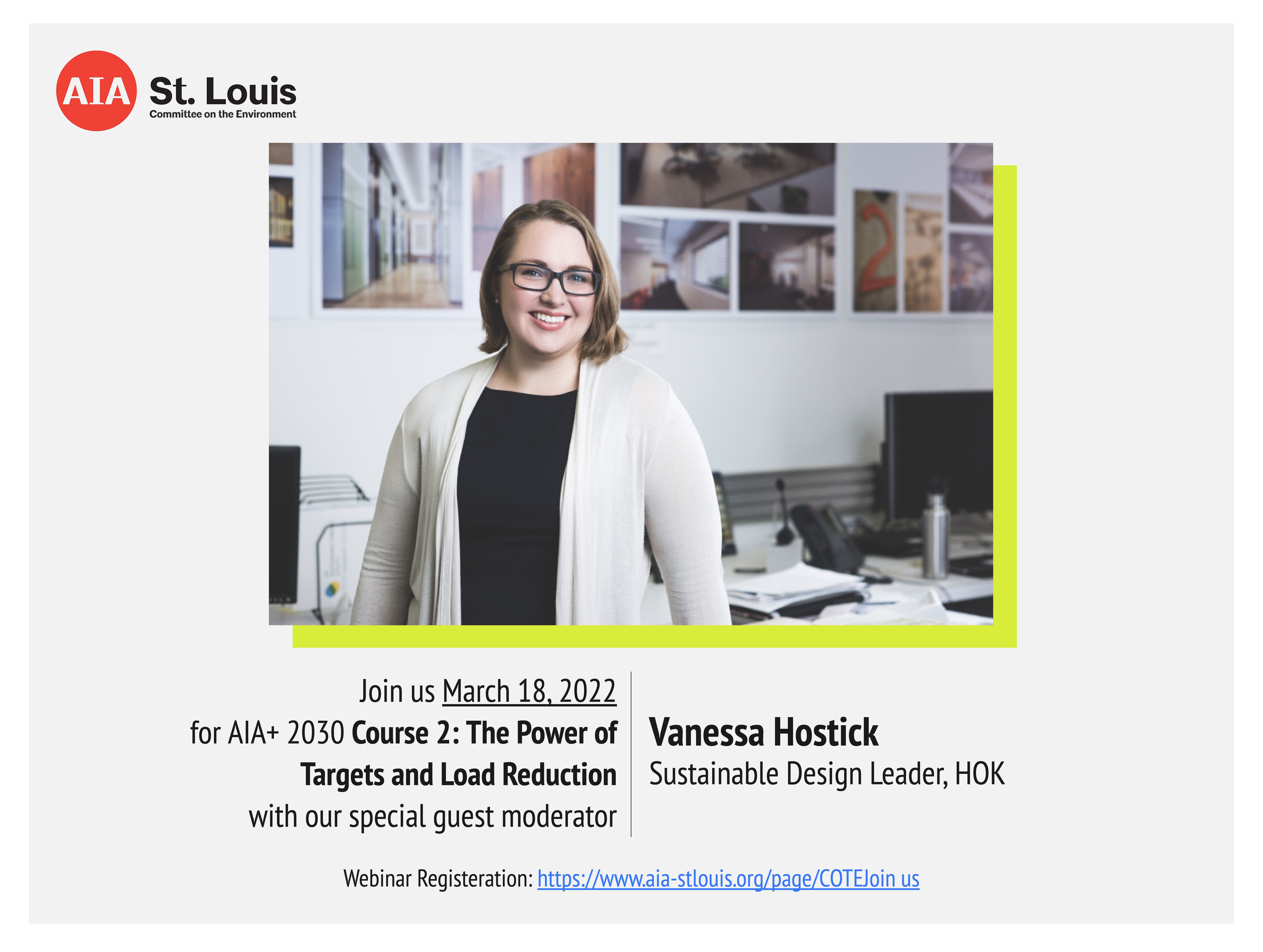
Overview: This week’s session will be moderated by Vanessa Hostick, Sustainable Design Leader at HOK. As Sustainable Design Leader, Ms. Hostick leads clients and consultants through decisions that promote environmentally responsible, equitable, and budget conscious design. She leverages her technical expertise to guide and advise teams, providing input to ensure consistent and high-performance design throughout the studio and across multiple markets. Utilizing her depth of knowledge in sustainability, integrated design, construction methodology, materials application, and green policies in addition to third-party green building certifications, Ms. Hostick champions sustainability as a critical path to help clients achieve their goals.
At HOK, she trains the next generation of sustainable leaders across the firm by coaching and motivating teams. Externally, she participates in local and national professional associations, building peer relationships and strives to increase sustainable awareness and commitment across the industry. She’s excited to be servicing as the AIA 2030 Working Group co-chair for the 2022 and 2023 cycles.
Description: The building sector is the single largest consumer of energy and producer of greenhouse gas emissions.The 2030 Challenge, adopted by the AIA, provides a path to reducing our sector’s negative impacts and reaching carbon neutral design as the standard practice. This series will inspire architects to meet the 2030 Challenge through design strategies, efficient technologies and systems, and applying renewable energy resources.
The 2030 Challenge outlines a set of incremental design targets moving towards carbon neutral design. Those targets should be part of the design process from the start of the project. This course examines tools that can help set your project’s energy targets and track progress towards those goals. You'll also learn about setting targets, not just for the whole building energy use, but for energy end uses of the building, which is critical to achieving results. Finally, you'll explore how energy modeling can be used at all stages of design to verify progress towards realizing the project’s goals.
The AIA+2030 Online Series is an AIA and Architecture 2030 co-production, sponsored by Autodesk and delivered through AIAU.
It's based on the highly successful AIA+2030 Professional Series, which was created by AIA Seattle and Architecture 2030, with support from the City of Seattle and Northwest Energy Efficiency Alliance. Learning Objectives: - Explain the incremental design targets outlined in the 2030 Challenge that move towards carbon neutral design
- Describe some of the primary tools available to assist architects in setting and tracking energy targets
- Discuss the importance of energy end use in setting targets and achieving results
- Describe how energy modeling can be used at all stages of design to verify progress towards realizing the project’s goals
Register: Click Here - limited to the first 100 registrants Credits: 1.00 LU|HSW RIBA Location: Zoom Sponsored by Ameren 
|


